
Academic
Sessions
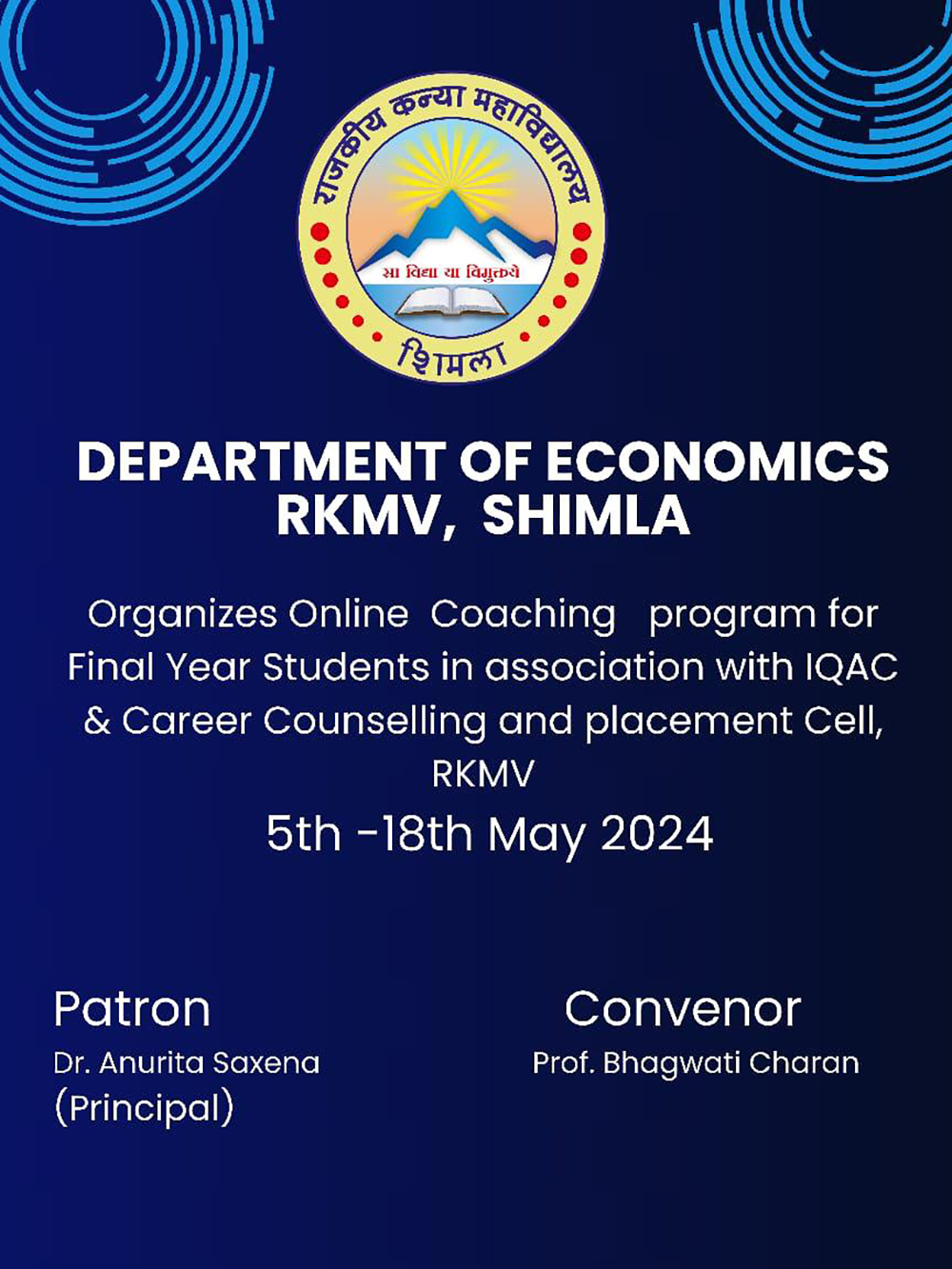 2023
– 24
2023
– 24
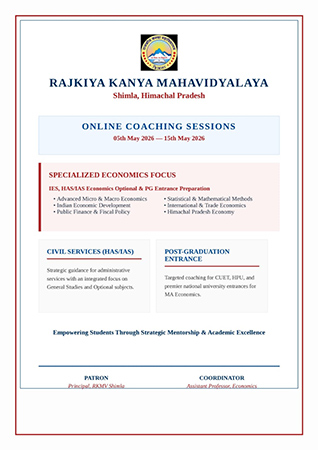 2025
– 26
2025
– 26
The Department of Economics is offering BA with Economics under the Choice Based Credit System (CBCS). The degree programme offered by the department of economics consists of Discipline Specific Core and Elective Courses, Skill Enhancement Courses and Generic Elective Courses. Apart from this department also provide opportunities to the students to apply their theoretical knowledge to contemporary economic world by involving them in seminars, workshops, field trips and conferences. Students are also encouraged to contribute their critical, analytical and creative ideas, research and other related issues through the ‘Planning Forum’ Section of the college magazine. The department also have a functional subject society namely “Economic Society” with subject teacher as its president and a student from Final Year as its vice-president.
Present Faculty
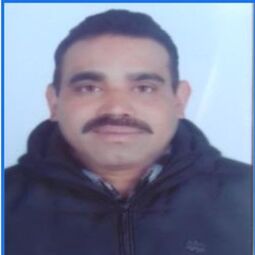
Dr. Satish
Kumar
Assistant Professor

Ms. Sandhya Kumari
Assistant Professor
Ms. Nivedita Chauhan
Assistant Professor| Name | Designation | Teaching Experience | Contact Number | E-mail ID |
|---|---|---|---|---|
|
Dr. Satish Kumar
|
Assistant Professor
|
15 Years
|
98161-54437
|
dr.satish14kumar@gmail.com
|
|
Ms. Sandhya Kumari
|
Assistant Professor
|
10 Years
|
-
|
sandhya.ch19@gmail.com
|
|
Ms.Nivedita Chauhan
|
Assistant Professor
|
1 Year
|
-
|
niveditachauhan21@gmail.com
|
Detail of Programmes / Students Strength
| B.A. ( Economics ) | |
|---|---|
| 1st Year | 42 |
| 2nd Year | 40 |
| 3rd Year | 44 |
Eligibility
| Programme/Course/Level | Duration | Eligibility | Admission Procedure |
|---|---|---|---|
|
B.A. /UG
|
3 years
|
10+2
|
On merit basis
|
Courses Offered in the Department
Following Courses are being offered by the
department for the successful completion of graduation degree in economics:
| DISCIPLINE SPECIFIC CORE (DSC) COURSES | ||
|---|---|---|
| Year | Discipline Specific Courses (DSC) | Course Code |
|
I
|
|
|
|
I
|
|
|
|
II
|
|
|
|
II
|
|
|
| DISCIPLINE SPECIFIC ELECTIVE (DSE) COURSES | ||
| Year | Discipline Specific Elective (DSE) | Course Code |
|
III
|
DSE – GROUP I (One out of the Following)
|
|
|
III
|
DSE 1: Indian Economy
|
ECONA301
|
|
III
|
DSE 2: Economic History of India 1857 – 1947
|
ECONA302
|
|
III
|
DSE 3: Economy of Himachal Pradesh
|
ECONA303
|
|
III
|
DSE 4: Basic Econometrics
|
ECONA304
|
|
III
|
DSE – GROUP II (One out of the Following)
|
|
|
III
|
DSE 5: Development Economics
|
ECONA305
|
|
III
|
DSE 6: International Economics
|
ECONA306
|
|
III
|
DSE 7: Mathematical Economics
|
ECONA307
|
|
III
|
DSE 8: Economic Systems
|
ECONA308
|
| SKILL ENHANCEMENT COURSES (SEC) | ||
| Year | Skill Enhancement Course (SEC) | Course Code |
|
II
|
SEC – I (One out of the Following)
|
|
|
II
|
SEC 1: Statistical Methods – I
|
ECONA203
|
|
II
|
SEC 2: Economics of Rural Development
|
ECONA204
|
|
II
|
SEC – II (One out of the Following)
|
|
|
II
|
SEC 3: Statistical Methods – II
|
ECONA205
|
|
II
|
SEC 4: Demography
|
ECONA206
|
|
III
|
SEC – III (One out of the Following)
|
|
|
III
|
SEC 5: Research Methodology
|
ECONA309
|
|
III
|
SEC 6: Public Finance
|
ECONA310
|
|
III
|
SEC – IV (One out of the Following)
|
|
|
III
|
SEC 7: Money & Banking
|
ECONA311
|
|
III
|
SEC 8: Project Work
|
ECONA312
|
| GENERIC ELECTIVE COURSES (GEC) | ||
| Year | Generic Elective Course (GEC) | Course Code |
|
III
|
GEC – I
|
|
|
III
|
GEC 1: Economy of Himachal Pradesh
|
ECONA313
|
|
III
|
GEC – II ( One out of the following)
|
|
|
III
|
GEC 2: Indian Economy
|
ECONA314
|
|
III
|
GEC 4: Development Economics
|
ECONA315
|
|
III
|
GEC 5: Environmental Economics
|
ECONA316
|
Specific Course Outcome of courses offered by the Department of Economics are:
| Name of the Course | Course Outcome |
|---|---|
|
Principles of
Microeconomics
|
This course is designed to
expose the student to the basic principles in Microeconomic
Theory and illustrate the same with applications.
|
|
Principles of
Macroeconomics
|
This course introduces
students to the basic concepts in Macroeconomics. Macroeconomics
and deals with the aggregate economy. In this course the
students are introduced to the definition, measurement of the
macroeconomic variables such as GDP, consumption, savings,
investment and balance of payments. The course also discusses
various theories of determining GDP in the short run. It also
introduces the student to concept of inflation, its relationship
with unemployment and some basic concepts in an open economy.
|
|
Indian Economy
|
This course is designed to
enable students to have in-depth knowledge of various problems
and issues faced by Indian Economy. The course will concentrate
on both the achievements and the issues of the economy.
|
|
Economic History of
India 1857 – 1947
|
This course analyses key
aspects of Indian economic development during the second half of
British colonial rule. This course links directly to the course
on India„s economic development after independence in 1947.
|
|
Economy of Himachal
Pradesh
|
This course highlights the
basic features, characteristics and developmental issues of the
Himachal Pradesh economy.
|
|
Basic Econometrics
|
This course provides a
comprehensive introduction to basic econometric concepts and
techniques. It covers statistical concepts of hypothesis
testing, estimation and diagnostic testing of simple and
multiple regression models.
|
|
Development Economics
|
This course reviews major
trends in aggregate economic indicators in India and places
these against the backdrop of major policy debates in India in
the post- Independence period.
|
|
International Economics
|
This course develops a
systematic exposition of models that try to explain the
composition, direction, and consequences of international trade,
and the determinants and effects of trade policy. The basic aim
of this course is to link international trade relations and its
impact on exports of nations.
|
|
Mathematical Economics
|
The main objective of this
paper is to train the students to use the techniques of
mathematical and statistical analysis, which are commonly
applied to understand and analyze economic problems. The
emphasis of this paper is on understanding economic concepts
with the help of mathematical methods rather than learning
mathematics itself. Hence in this paper a student will be
initiated into various economic concepts, which are amenable to
mathematical treatment.
|
|
Economic Systems
|
This course seeks to enrich
the knowledge of the students regarding working of various
economic systems. The course does not require any prior
knowledge of economics.
|
|
Statistical Methods
|
This course introduces the
student to collection and presentation of data. It also
discusses how data can be summarized and analysed for drawing
statistical inferences. The students will be introduced to
important data sources that are available and will also be
trained in the use of free statistical software to analyse data.
|
|
Economics of Rural
Development
|
This course is designed to
instill in the student a deeper understanding of rural
development and issues therein. The student is expected to also
achieve an appreciation of institutional efforts aimed at
achieving rural development.
|
|
Demography
|
The main objective of this
paper is to make the students aware of the importance of
population in economic development and the various theories that
explain the growth of population in a country. The study of
Quantitative and Qualitative composition of population is also
required to understand the dynamics of population growth.
|
|
Research Methodology
|
This course is designed to
rigorously train the students in the concepts, methodology and
reasoning involved in analyzing economic behavior of firms and
markets, in general, in both static and partial equilibrium
frameworks.
|
|
Public Finance
|
This course is a
non-technical overview of government finances with special
reference to India. The course does not require any prior
knowledge of economics. It will look into the efficiency and
equity aspects of taxation of the centre, states and the local
governments and the issues of fiscal federalism and
decentralization in India. The course will be useful for
students aiming towards careers in the government sector, policy
analysis and business.
|
|
Money and Banking
|
This course exposes
students to the theory and functioning of the monetary and
financial sectors of the economy. It highlights the
organization, structure and role of financial markets and
institutions. It also discusses interest rates, monetary
management and instruments of monetary control. Financial and
banking sector reforms and monetary policy with special
reference to India are also covered. The course does not require
any prior knowledge of economics. .
|
|
Project Work
|
Project Work is one of the
culmination point of the learning process, which will put to
test the acquired ability of the candidate to independently take
the charge of the project and use the understanding of economics
developed in previous years to evaluate/analyze economic issues.
|
|
Environmental Economics
|
This course focuses on
economic causes of environmental problems. In particular,
economic principles are applied to environmental questions and
their management through various economic institutions, economic
incentives and other instruments and policies. The course does
not require any prior knowledge of economics. The course will be
useful for students aiming towards careers in the government
sector, NGOs, policy analysis, business and journalism.
|